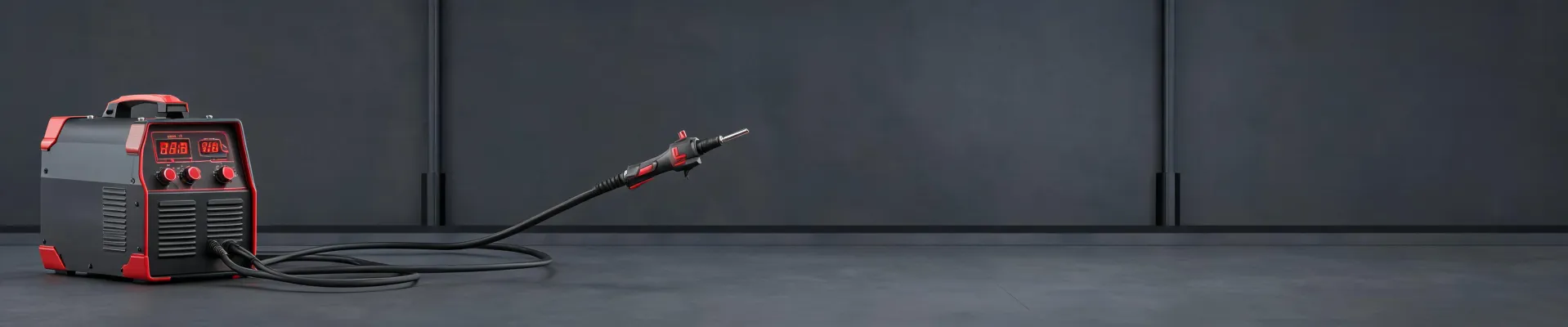
A Failed Weld Inspection Changed How I Evaluate Welding Equipment — Here's the Full Story
Posted on 2026-09-29 by Rina Matsuda
It was a Tuesday morning in March 2023 when our lead welder put three components on my inspection bench. He didn't say anything — just pointed at the welds.
He didn't need to explain. Insufficient penetration. Undercut beyond what AWS D1.1 visual acceptance allows. I'm the quality compliance manager at a contract manufacturing operation in the Midwest — we run about 14,000 welded components a year — and this was our third hold that quarter.
The first two times, we blamed operator technique. This time was different: same welder, same fixture, same parameter sheet, and the exact same setup had passed inspection the previous week.
Something had changed. And it wasn't the person holding the torch.
What Actually Happened
I did what any quality manager does under pressure — I turned it into a project. Over the next two weeks, I ran a full welding machine inspection across every unit on our floor. Not just the visual stuff, either. I checked output stability under load, wire feed consistency, gas flow calibration, and duty cycle performance against manufacturer specs.
We had 18 machines in active service. Four of them were more than six years old and had never been formally re-verified after installation. I took photos of each machine's data plate and current readings — I keep a welding machine image folder for every asset now, which sounds obsessive until an auditor asks for documentation (then it's a lifesaver).
Two of those older units were running 8-12% below their rated output at the torch. Not enough to fail a casual test, but enough to explain marginal welds on thicker material. On 3/8" plate with a root gap, that 10% shortfall is the difference between passing and failing.
I hadn't caught it earlier because we'd never tested under actual load conditions. We tested arc start, we checked the display, we moved on. Lesson learned.
The Replacement Decision
Now I needed to replace four machines. Budget was set. Timeline was tight. And I had to justify every dollar to a CFO who doesn't weld.
"An informed customer asks better questions and makes faster decisions."
That's something I actually said to my own team during this process. Because I realized I'd been making equipment decisions on brand familiarity rather than verified performance data.
I started broad. Looked at everything from the MIG welders you can buy at Menards to the high-end industrial units. The Menards option was tempting on paper — I mean, you can walk in, grab a unit off the shelf, and have it running the same day. For a shop doing light fabrication, that's a real advantage. But when I looked at duty cycle specs and compared them to our production demands, the math didn't work. We run 6-8 hour shifts with maybe 40% arc-on time. Those consumer-grade units are rated for significantly less.
I also realized that retail-channel MIG welders are designed for a different risk profile than ours. If a hobbyist's machine overheats, they stop and have a beer. If ours overheats mid-production, we miss a ship date.
Fronius came up because one of our senior welders had used their TIG equipment at a previous shop and wouldn't stop talking about it. I was skeptical — I'd heard the brand name, knew they were Austrian, knew they had a reputation for quality. But reputation doesn't pay for itself. I needed data.
Digging Into the Details
I reached out to Fronius through their contact page — honestly, I expected a sales pitch and a slow response. What I got was a technical application engineer who asked me more questions about our process than I asked about their product. That was disarming.
We went through our typical joint configurations, material thicknesses, wire types, and environmental conditions. He pulled up our specific duty cycle requirements against their machine specs and showed me where certain models would work and where they wouldn't. No hard sell on the top-of-the-line unit. Just honest fit analysis.
One model that caught my eye was the AccuPocket 150/400 — a portable unit that runs on both battery and mains power. For our field service work, that flexibility mattered. I checked the Fronius AccuPocket 150/400 price and it was in the $4,200-$5,500 range depending on configuration and accessories (that was Q4 2024 pricing — verify before you budget, this stuff moves). Not cheap. But when I compared total cost of ownership against replacing a cheaper unit every 2-3 years, the math started favoring the investment.
Here's where I had to check myself: everything I'd read about equipment purchasing said buy the most machine you can afford. In practice, for our specific mix of shop work and field service, the mid-range Fronius units actually fit better than the top-tier models. We didn't need the extra capacity, and the weight and footprint penalty would've been a daily annoyance.
The Unexpected Twist
I'd gone into this process planning to buy four units from one brand. Seemed simpler for training and parts commonality. But after running side-by-side comparisons — I set up a blind test where our welders ran the same joints on three different machines without knowing which was which — the results split.
Two of our applications clearly favored the Fronius units. The arc stability on thin-gauge material was noticeably better, and our welders could tell even without seeing the brand. But for one heavy-fab station, a different brand's machine actually produced better results with our specific wire and gas combination. It wasn't that the Fronius was worse — it's that arc characteristics interact with consumables in ways that don't always show up on a spec sheet (worth noting if you're evaluating equipment for a specific wire type).
So I ended up buying three Fronius units and one from another manufacturer. My CFO wasn't thrilled about splitting the order, but my welders were. And our rework rate on those three stations dropped from 6.2% to 1.8% over the next quarter.
That's not a Fronius-specific number. It's what happens when you match equipment to specific application requirements instead of buying based on brand reputation alone.
What I'd Tell Anyone Doing This Now
I can only speak to our situation — a mid-size contract shop with predictable production runs and a mix of shop and field work. If you're a job shop with wildly varying requirements, or if you're doing field work in remote locations without reliable power, the calculus might be different.
But here's what I think holds true regardless of your specifics:
- Inspect under load, not just at idle. A machine can read fine on the display and still underperform at the arc. Load testing should be part of your welding machine inspection routine.
- Take photos and document everything. A welding machine image log with data plates, serial numbers, and current readings is worth its weight in gold when you're trying to justify a replacement or diagnose a problem.
- Don't assume brand name equals best fit. The reputation is real, but fit is application-specific. Test before you commit.
- Talk to the manufacturer's technical team, not just the sales team. If you can get an application engineer on the phone, do it. The questions they ask tell you more about the company than any brochure.
That failed inspection in March 2023 was a wake-up call. It cost us three days of production and a lot of uncomfortable conversations. But it also led to a process that's saved us far more than the equipment investment itself.
The machines matter. But knowing why you're choosing them matters more.
This was accurate as of early 2025. Equipment pricing and availability change fast — verify current specs and pricing before making purchasing decisions.

Rina Matsuda
Rina Matsuda is a garment-production machinery analyst covering industrial lockstitch, overlock, coverstitch, buttonhole, pattern-sewing, and multihead embroidery machines with feeding and thread-management systems. She applies ISO 10821 safety requirements while examining stitch length, stitch density, thread tension, seam balance, presser-foot pressure, needle system, sewing speed, trim cycle, hoop registration, changeover time, and defect rate. Her technical guides help apparel factories, embroidery businesses, and production engineers match machine configuration, automation level, material behavior, operator workflow, and line-capacity targets.
Leave a Reply
Recent welding notes
The Cheap Marking Equipment Trap: Why Code Quality Is a Brand Decision
A purchasing manager's deep dive into the hidden costs of CO2 laser marking machines, continuous inkjet printers, and other marking equipment—and why output quality shapes customer perception.
Audio Factory vs Audio Manufacturer: Small-Order Buying for Stage Speakers, Subs, and Point Source Gear
A procurement admin compares factory-direct audio suppliers and established audio manufacturers for small orders—MOQs, point source speakers, subwoofers, HDL20 stage speakers, support, and total cost.
Fronius, Wattpilot Pricing, and the Welding Questions I Actually Get Asked
A procurement manager's no-fluff answers on Fronius welders, Wattpilot Australia pricing, stick welder value, Menards MIG welder options, roaddogjobs welder listings, and what a PPR welding machine actually is.
Why I Choose Specialized Welding Suppliers Over 'One-Stop' Industrial Vendors
An admin buyer's argument for specialization in welding equipment purchasing, from Fronius Primo 5.0-1 pricing to welding carts, Rogue TIG welders, manipulators, and the Mexico electric welding machine market.
Why I Pay for Delivery Certainty on an Elite Welding Machine — and Where Fronius Fits
A procurement manager explains why the cheapest welding quote often costs more, how to evaluate MIG welder purpose, small TIG welders for aluminum, and why Fronius downloads matter for TCO.
Fronius Cobot Welding System: How I Saved a $42K Girth Welding Contract with 36 Hours to Spare
An emergency welding contractor shares the real story of rescuing a failed girth welding project using a Fronius cobot welding system, TIG welder electrodes, and a used laser welding machine—plus what I learned about Fronius Primo 5.0-1 pricing and equipment sourcing.
Fronius Welders, Ohmpilot Pricing, and Truck-Bed Rigs: 7 Questions I Actually Get Asked
Straight answers on Fronius welder value, Fronius Ohmpilot price ranges, ventilation setups, truck-bed welding rigs, and what's actually moving in welding machine news — from someone who coordinates emergency equipment orders for a living.
Fronius vs Millermatic 211 Pro vs Ruffian: How to Choose a MIG Welder by Scenario
A procurement admin's scenario-based guide to MIG welder selection, including Fronius welder reviews, Millermatic 211 Pro MIG welder, Ruffian welding machine, and Fronius Smart Meter 63A-3 price in Germany.
The Procurement Trap: Why a Cheap Welding Machine 250 Costs More Than It Saves
A purchasing administrator's deep dive into why cheap welding equipment hurts quality perception, uptime, and total cost—and how Fronius, Rebel AC/DC welders, Fronius welder parts, and laser systems fit into a smarter buying process.
Fronius, Small Orders, and the Hidden Cost of Cutting Corners in Welding and Solar
A quality manager explains why small orders for Fronius welders, commercial grid-tie solar inverters, and fiber optic welding machines often hide bigger costs—and how to verify specs without overpaying.